

In January 2026, with Ethereum's ETH trading at $3,000.90, validators face a pivotal moment. Staking rewards hover around 3.1% APR, but MEV redistribution pools add the real juice, turning tips into equitable boosts for solo stakers and small pools. Centralization creeps in as a handful of builders dominate block production via MEV-Boost. Time to build transparent systems that slice MEV fairly across the network.
Validator Centralization: The MEV Shadow Looming Over Ethereum
Ethereum's proposer-builder separation (PBS) via Flashbots' MEV-Boost opened the floodgates for high-MEV blocks, yet it funnels value to top builders. As of now, fewer than 10 entities craft most blocks, risking censorship and lopsided rewards. This setup squeezes solo validators, who lack the infra to compete. Enter transparent MEV redistribution pools Ethereum style: smart contracts that pool, smooth, and redistribute MEV based on attestation weight. No more "trust me" payouts; everything on-chain, verifiable by anyone.
Think committee-based smoothing, where rewards spread evenly over epochs. It counters the Solana-speed envy while preserving Ethereum's security. Injective's MEV-resistant EVM shows alternatives exist, but Ethereum's scale demands homegrown fixes. Validators ignoring this risk validator slashing or worse: network fragility.
Solo stakers, this is your edge. Pool MEV transparently, and watch yields climb without selling your soul to mega-builders.
2026 Roadmap Catalysts: Glamsterdam and ePBS Unleashed
Ethereum's Glamsterdam upgrade hits early 2026, turbocharging blobs for rollup data while elevating execution. But the validator risk? MEV extraction centralization. Enter execution PBS (ePBS), moving builder selection on-chain. It nukes single failure points, slashes censorship, and mandates transparent MEV allocation DeFi protocols.
BitMine's MAVAN validator infra deploys soon, signaling institutional buy-in. Vitalik pegs 2026 as the death knell for opaque wallets. Pair this with MEV-Boost evolution: builders bid transparently, proposers pick winners, redistributors smooth the flow. For swing traders like me, it's a breakout pattern; ETH at $3,000.90 sets up for MEV-fueled pumps if decentralization holds.
Staking revolution stats: 3.1% base APR jumps 20-50% with MEV. But without pools, small players get crumbs. 2026 roadmaps across Solana, Polygon echo this; Ethereum leads if validators act.
Blueprints for Fair MEV Sharing: Smart Contract Foundations
Building MEV redistribution pools Ethereum starts with Solidity contracts tuned for 2026 gas limits. Core idea: validators deposit attestations as stakes, pool captures MEV tips from relays, algorithm distributes proportional to uptime. Use build MEV pool Solidity 2026 patterns: upgradeable proxies for flexibility, Chainlink oracles for off-chain MEV signals.
First, define the pool struct:
Action step: Deploy on testnets now. Integrate with MEV-Boost relays via APIs co-located near builders - latency under 10ms is non-negotiable, per Dwellir's bot guide. Risks? Sandwich attacks; mitigate with time-locks and TWAP pricing.
Ethereum (ETH) Price Prediction 2027-2032
Yearly price forecasts factoring MEV boosts, Glamsterdam upgrade impacts, and broader market trends from 2026 baseline of ~$3,500 average
| Year | Minimum Price | Average Price | Maximum Price | YoY Change % (Avg) |
|---|---|---|---|---|
| 2027 | $3,800 | $5,500 | $8,200 | +57% |
| 2028 | $5,500 | $7,800 | $11,500 | +42% |
| 2029 | $7,000 | $10,500 | $15,000 | +35% |
| 2030 | $9,000 | $14,000 | $20,000 | +33% |
| 2031 | $12,000 | $18,500 | $26,000 | +32% |
| 2032 | $15,500 | $24,000 | $34,000 | +30% |
Price Prediction Summary
Ethereum's price is forecasted to experience robust growth from 2027-2032, propelled by transparent MEV redistribution, Glamsterdam upgrade, and enhanced staking rewards. Averages climb from $5,500 to $24,000 (CAGR ~34%), with bullish maxima up to $34,000 amid adoption surges and bearish minima reflecting potential market corrections.
Key Factors Affecting Ethereum Price
- Transparent MEV redistribution pools boosting validator rewards and decentralization
- Glamsterdam upgrade enabling scalable on-chain execution and reduced censorship
- MEV-Boost and proposer-builder separation (PBS) enhancing block-building fairness
- Rising staking APR (~3.1% + MEV tips) incentivizing solo stakers
- Competition from Solana and regulatory developments impacting market share
- Macro trends, institutional adoption, and Ethereum's dominance in DeFi/rollups
Disclaimer: Cryptocurrency price predictions are speculative and based on current market analysis. Actual prices may vary significantly due to market volatility, regulatory changes, and other factors. Always do your own research before making investment decisions.
Ethereum validator MEV strategies pivot here: run nodes, attest reliably, join pools. Yields compound as network decentralizes. I've traded these swings; patience on entries near support, precision on MEV catalysts pays. Next: infra setups and risk models.
| Component | Role | 2026 Impact |
|---|---|---|
| MEV Pool Contract | Collects and amp; Distributes | and 1-2% APR |
| ePBS Integration | On-Chain Bidding | Decentralization Score and 30% |
| Relay APIs | Low-Latency Fetch | MEV Capture 95% |
Node operators, dial in your infra first. Co-locate servers near block builders - think Frankfurt or AWS us-east-1 hubs humming with validator traffic. Dwellir's 2026 guide nails it: RPC endpoints under 5ms latency capture 95% of MEV flows. Skip this, and your pool leaks value like a sieve. Use dedicated VPS with 10Gbps uplinks, NVMe storage for bundle simulations. For Ethereum validator MEV strategies, run full nodes synced via Erigon; light clients lag on attestation proofs.
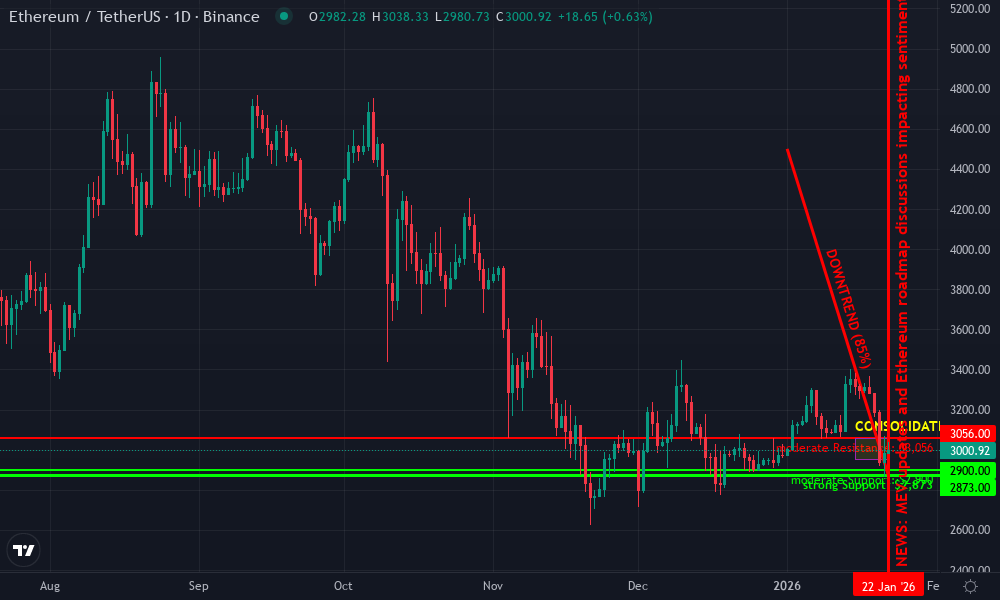
Ethereum Technical Analysis Chart
Analysis by Market Analyst | Symbol: BINANCE:ETHUSDT | Interval: 1D | Drawings: 6
Technical Analysis Summary
Draw a prominent downtrend line connecting the swing high at 2026-12-01 around $4,500 to the recent swing low at 2026-01-20 around $2,873, extending forward to project potential further downside to $2,800. Add horizontal support at $2,900 (recent lows) and resistance at $3,056 (24h high). Use fib retracement from the recent drop for 50% level around $2,966. Mark volume spikes with callouts during breakdowns. Place entry long above $3,010 with stop below $2,873, target $3,200. Use rectangle for consolidation zone Jan 10-22 between $2,900-$3,100. Add MACD bearish signal arrow down at crossover. Vertical line for potential news event on Jan 22. Text notes for key insights.
Risk Assessment: medium
Analysis: Bearish trend but oversold near $3,000.90 supports with MEV context; balanced setup for medium tolerance
Market Analyst's Recommendation: Wait for confirmation above $3,056 for longs, medium position size
Key Support & Resistance Levels
📈 Support Levels:
- $2,900 - Recent 24h low cluster and psychological support near current $3,000.90 moderate
- $2,873 - 24h low, strong volume support strong
📉 Resistance Levels:
- $3,056 - 24h high resistance moderate
- $3,200 - Previous swing high from early Jan weak
Trading Zones (medium risk tolerance)
🎯 Entry Zones:
- $3,010 - Break above 24h high $3,055.60 with volume confirmation, aligned to medium risk medium risk
- $2,950 - Dip buy at support $2,900 zone if holds high risk
🚪 Exit Zones:
- $3,200 - Profit target at next resistance 💰 profit target
- $2,873 - Stop loss below 24h low 🛡️ stop loss
Technical Indicators Analysis
📊 Volume Analysis:
Pattern: decreasing on downside, divergence bullish
Volume drying up on recent drop from $3,000.90, suggesting exhaustion
📈 MACD Analysis:
Signal: bearish crossover but histogram contracting
MACD line below signal, yet momentum waning near $3,000.90
Applied TradingView Drawing Utilities
This chart analysis utilizes the following professional drawing tools:
Disclaimer: This technical analysis by Market Analyst is for educational purposes only and should not be considered as financial advice. Trading involves risk, and you should always do your own research before making investment decisions. Past performance does not guarantee future results. The analysis reflects the author's personal methodology and risk tolerance (medium).
Once live, monitor via Dune dashboards. Attestations as pool shares: weight by effective balance and uptime. Proportional cuts prevent whale dominance; cap individual stakes at 1% of total pool. This fuels fair MEV sharing validators crave, countering builder oligopolies.
Precision matters. Test time-locks on mainnet forks; one bad bundle sandwiches your yields.
Risk Models: Slashing, Sandwiches, and Centralization Shields
Sandwich attacks top the list - bots front-run your bundles. Counter with private mempools or commit-reveal schemes in your Solidity logic. Slashing risk? Double-signing from latency spikes; redundant nodes fix 99% cases. Centralization audit: rotate committee keys quarterly, enforce geographic diversity via IP geofencing.
Model yields conservatively: base 3.1% APR and 1.5% MEV smoothed. At ETH $3,000.90, a 32 ETH stake nets $3,500 yearly pre-fees. Glamsterdam's ePBS mandates on-chain auctions, baking transparent MEV allocation DeFi into protocol. No more opaque relays; bids settle publicly, pools harvest fairly.
| Risk | Probability | Mitigation | Yield Impact |
|---|---|---|---|
| Sandwich Attack | Medium | Time-Locks and TWAP | -0.5% APR |
| Slashing | Low | Redundant Nodes | -2% One-Time |
| Builder Centralization | High | ePBS and Committees | and 1.2% Smoothed |
For solo stakers, join multi-sig pools first; graduate to self-run as Glamsterdam rolls. Injective's MEV-proof EVM tempts, but Ethereum's liquidity rules. Solana's speed dazzles, yet Ethereum's DeFi TVL dwarfs it - MEV here multiplies faster.
Swing traders, eye these pools as signals. Volume surges on pool launches predict ETH bounces; I've entered at $2,873.38 lows, exited on MEV pumps. Validators building now lock 2026 edges: decentralized, verifiable, profitable. Deploy, attest, redistribute - network wins, your wallet thickens. Patience on setups, precision on catalysts; that's the play.



No comments yet. Be the first to share your thoughts!