

In the high-stakes arena of decentralized finance, where every basis point counts, Miner Extractable Value, or MEV, has long been a silent predator, siphoning profits from everyday traders and protocols alike. Wallchain flips this script through innovative MEV redistribution, channeling those extracted gains directly back to DeFi users and fostering genuinely fairer markets. This isn't just another band-aid; it's a structural shift toward DeFi MEV sharing that empowers participants rather than enriching a select few searchers.

The blockchain's permissionless nature breeds opportunity, but also exploitation. Searchers, sophisticated bots scanning the mempool, reorder transactions to front-run trades, sandwich user swaps, or liquidate positions at optimal moments. Billions in value get captured annually, yet users foot the bill through slippage and worsened prices. Ethereum's ecosystem, powered by tools like MEV-Boost, amplifies this, while Solana grapples with validator-centric extraction. Enter Wallchain: a seed-stage protocol delivering an API that upgrades transactions, capturing Wallchain MEV and splitting it equitably between dApps and users.
Unpacking the MEV Extraction Machine
MEV manifests in myriad forms, from arbitrage on DEXes to liquidation cascades in lending protocols. On Ethereum, Flashbots' relay system funnels the bulk of blocks, concentrating power among top searchers. Solana's faster finality curbs some Ethereum-style bots but invites malicious validators to reorder via Jito bundles. The result? Users suffer redirect MEV to users invisibly, eroding trust and efficiency.
Wallchain changes this by integrating directly with dApps and DEX aggregators to deliver ETH cashback back to the users.

Recent innovations underscore the urgency. Chainlink's Smart Value Recapture recaptures non-toxic MEV from price feeds, collaborating with Aave for v3 integration. ShroudFi deploys AI and ZK proofs to cloak transactions from bots. Yet these tackle symptoms; Wallchain targets the root by making fair MEV markets the default through seamless profit redirection.
Wallchain's API: The Engine of Equitable Redistribution
At its core, Wallchain provides a plug-and-play API for DeFi platforms. When a user initiates a swap, the protocol bundles it with searcher activity, capturing arbitrage or kickbacks that would otherwise vanish into private wallets. Profits split, say, 50/50 between dApp and user, manifest as ETH rebates, reducing effective fees and boosting yields.
This MEV redistribution model thrives on transparency. Unlike opaque relays, Wallchain's integration ensures users see rebates in real-time, verifiable on-chain. For protocols, it's a retention magnet: imagine DEXes like Uniswap or aggregators like 1inch offering native cashback, outpacing competitors stuck in the MEV grind.
Strategic Advantages in a Multi-Chain World
Wallchain's Ethereum focus aligns with DeFi's gravity, but Solana's evolution, via restaking like Solayer, hints at cross-chain potential. There, MEV capture could supercharge DEXes, lending, and perps by rebating to liquidity providers. Developers gain analytics on captured value, refining strategies for sustainable growth.
Critically, this curbs MEV bots protection needs by design. No more frantic relay shopping; Wallchain internalizes extraction, aligning incentives. Protocols see revenue diversification beyond emissions, users enjoy lower costs, and searchers compete on fair terms. As L2s proliferate, Wallchain positions early adopters to dominate DeFi MEV sharing flows, much like how MEV-Boost reshaped Ethereum post-Merge.
Learn more about MEV distribution models in our comparative analysis.
Developers integrating Wallchain report measurable uplift in user engagement, as rebates compound into sticky liquidity. Picture a trader on a DEX aggregator: instead of losing 0.5% to sandwiches, they pocket half the arbitrage, turning a routine swap into a micro-profit center. This redirect MEV to users dynamic not only levels the playing field but redefines protocol economics, where captured value fuels growth loops.
Comparison of MEV Solutions
| Solution | Mechanism | Chain | User Benefit | Protocol Revenue |
|---|---|---|---|---|
| Wallchain | API integration for MEV capture and redistribution via transaction upgrades | Ethereum | ETH rebates and cashback directly to users/dApps | Shared MEV profits with dApps |
| Chainlink SVR | Oracle-based non-toxic MEV recapture using Price Feeds | Ethereum | Fairer markets and rates for users (e.g., Aave) | Recaptured MEV to protocol treasury (e.g., Aave) |
| ShroudFi | AI-powered MEV protection with threat detection, private relays, and ZK proofs | Ethereum | Transactions invisible to MEV bots, protection from exploitation | Fee-based services (protection revenue) |
| Flashbots | Relays for MEV bundle auctions and proposer-builder separation | Ethereum | Reduced sandwich attacks and front-running | Searcher bids distributed to block proposers |
| Jito | Bundles for atomic transaction execution and MEV ordering | Solana | Efficient MEV handling, protection from malicious validators | Portion of bundle tips and fees |
Such granularity demands robust analytics, which Wallchain supplies via dashboards tracking rebate flows and searcher efficiency. In a sector plagued by black-box extraction, this visibility arms protocols with data to negotiate better splits or optimize bundle construction. Early adopters, particularly DEXes and aggregators, stand to capture a slice of the $1B and annual MEV pie, transforming waste into wealth.
Navigating Solana's Validator-Dominated MEV Terrain
Solana's architecture, with its high-throughput blocks and Gulf Stream mempool, sidesteps Ethereum's bot swarms but breeds validator greed. Jito's bundle auctions enable ordered inclusion, yet frontrunning persists through malicious reordering. Wallchain's forthcoming Solana support could mirror Ethereum's success, bundling user intents with conditional liquidity to rebate Wallchain MEV in SOL or stablecoins. Pair this with restaking primitives like Solayer, and DeFi protocols unlock compounded yields: MEV rebates funneled back to LPs, amplifying TVL without inflationary tokens.
Solana's MEV landscape has entered a new phase - one where malicious validators rather than external bots have taken center stage.
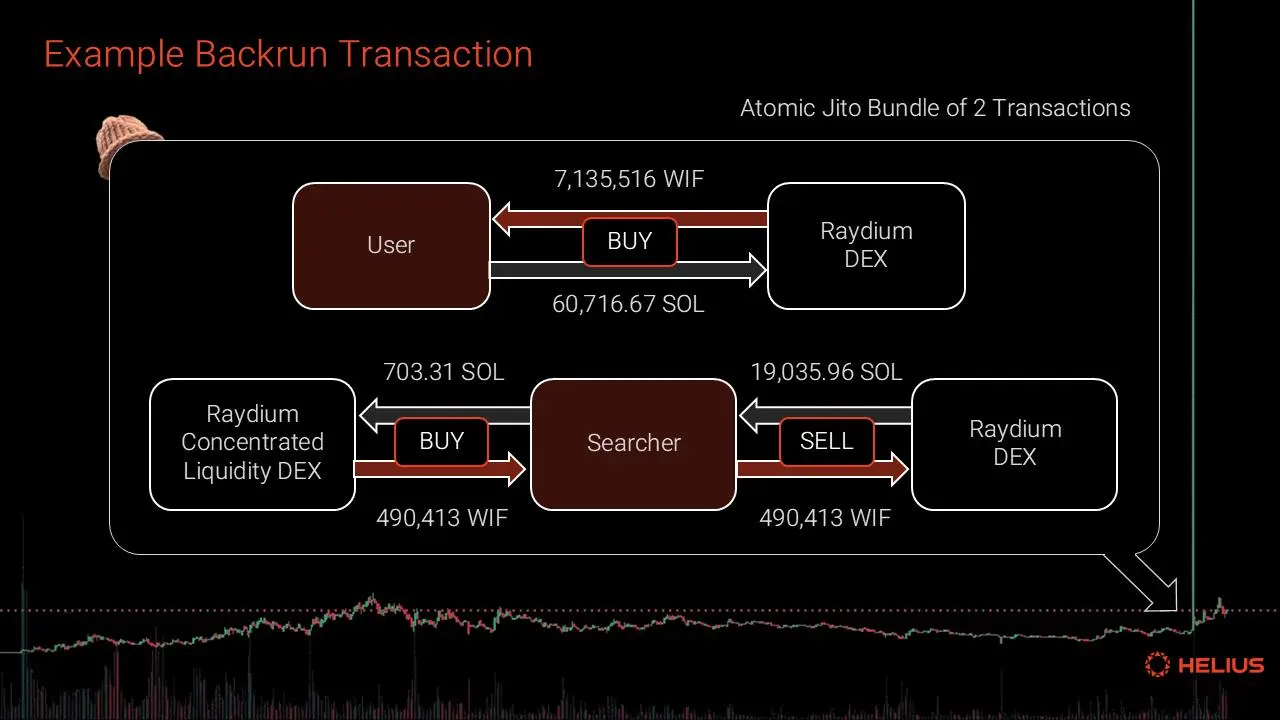
Yet Solana's speed introduces wrinkles. Latency-sensitive arbitrage demands sub-slot precision, challenging API upgrades. Wallchain's edge lies in hybrid searcher partnerships, ensuring bundles execute optimally while prioritizing user rebates. This positions Solana DEXes like Jupiter or lending markets to leapfrog Ethereum in fair MEV markets, where extraction serves the ecosystem, not undermines it.
Challenges persist across chains. Searcher collusion could dilute rebates, necessitating vigilant monitoring and slashing mechanisms. Regulatory scrutiny looms as MEV rebates blur lines between yields and securities. Still, Wallchain's decentralized governance model, vesting tokens to early integrators, fosters alignment. Compared to pure blockers like MEV Blocker, which merely censor toxic flows, Wallchain monetizes the good MEV, creating net positive sum games.
Explore how MEV redistribution protocols are transforming DeFi user rewards for protocol-specific tactics. As L2s like Base and Arbitrum scale DeFi, Wallchain's API scales with them, embedding rebates natively. Users gain MEV bots protection without friction, protocols diversify revenue, and searchers pivot to value creation. The outcome? A matured MEV market where extraction evolves into equitable sharing, fortifying DeFi against centralization risks and propelling sustainable adoption. Forward-thinking builders recognize this shift not as optional, but as the cornerstone of enduring protocol dominance.




No comments yet. Be the first to share your thoughts!