
What changed in MEV extraction 2026
The landscape of Maximal Extractable Value (MEV) extraction has shifted from manual botting to AI-driven searchers. In 2023, the average daily MEV extraction reached approximately $1.5 million, highlighting its significant impact on network dynamics. By late 2025 and early 2026, this figure surged as advanced algorithms began dominating the mempool. Between December 8, 2025, and January 6, 2026, searchers pulled roughly $24 million in MEV profit from Ethereum alone.
This acceleration marks a structural change in how value is captured on-chain. AI searchers no longer rely on static rules; they adapt to real-time gas markets and transaction patterns. On certain Layer 2 networks, bots now consume over 50% of all gas just hunting for profitable opportunities. This density of competition forces human operators and older bot architectures out of the market.
The scale of this activity is visible in the broader crypto economy. As Ethereum's price fluctuates, the profitability of these extraction strategies shifts accordingly.
How AI searchers optimize block space
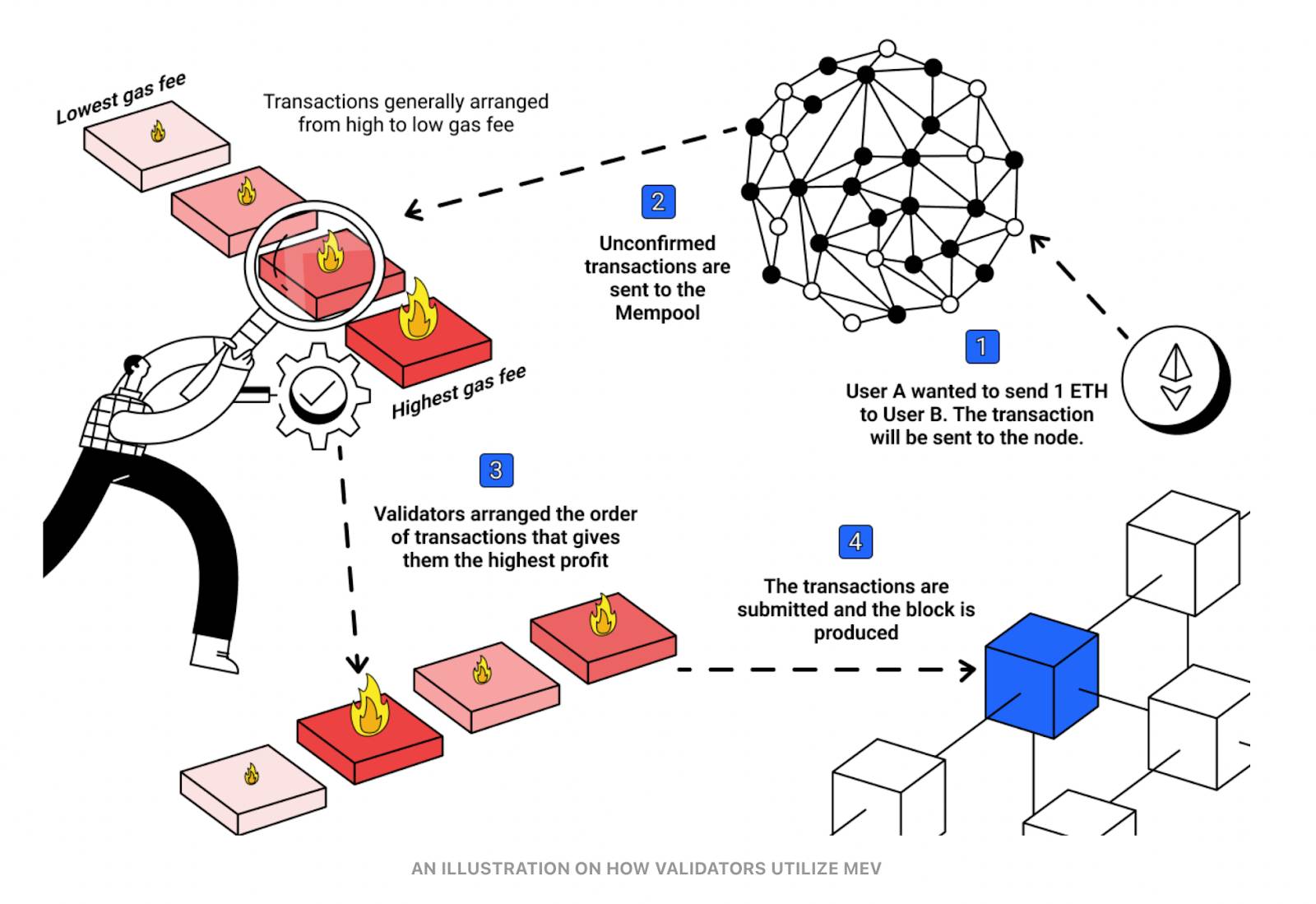
AI-driven searchers have shifted MEV extraction from heuristic-based reordering to predictive execution. In 2026, the competitive edge lies not in who can build the fastest relayer, but in who can most accurately forecast transaction inclusion probabilities. These models analyze the mempool to predict which pending transactions will successfully land in the next block, allowing searchers to bid on block space with precision that human operators cannot match.
The core mechanism involves real-time simulation. Searchers run thousands of parallel simulations of potential transaction sequences against the current state of the blockchain. By estimating the gas cost and success rate of each path, the AI identifies the most profitable ordering. This process effectively turns block space into a dynamic market where price is determined by the marginal utility of inclusion. The searcher with the most accurate prediction model captures the highest value, while less accurate models result in failed transactions and wasted gas.
This optimization creates a feedback loop that tightens the gas market. As AI models become more sophisticated, the cost of inclusion rises because searchers are willing to pay higher premiums for guaranteed execution. This pressure forces regular users to compete against algorithmic traders for block space, often resulting in higher baseline gas fees during peak activity. The efficiency of the AI means that arbitrage opportunities are closed faster, but the cost of accessing that liquidity increases.

The result is a market where block space is allocated to the highest bidder with near-perfect efficiency. This reduces the window for traditional arbitrage but increases the overall value extracted from the blockchain. For the network, this means higher revenue for validators, but for the ecosystem, it raises questions about centralization and the accessibility of transaction inclusion for non-professional participants.
Flashbots trends and private order flow
By 2026, the landscape of Maximal Extractable Value (MEV) extraction has shifted decisively away from the public mempool. Flashbots and private relays now dominate the infrastructure, allowing searchers to submit transactions directly to block builders without exposing them to the public mempool where front-running bots typically operate. This migration reduces the "race condition" risk that previously defined high-stakes arbitrage, turning MEV extraction into a more structured, albeit still competitive, market.
Private order flow has become the standard for large traders and protocols seeking to minimize slippage and prevent predatory extraction. Instead of broadcasting trades to the open mempool, these actors route orders through private relays, ensuring that the trade execution is bundled directly into a block by a builder who has been compensated for the MEV opportunity. This process effectively privatizes the value extraction, creating a more predictable environment for liquidity providers while concentrating power among a smaller set of sophisticated searchers and builders.
The move toward decentralized MEV solutions is gaining traction as the community seeks to mitigate the centralization risks associated with dominant private relays. New protocols are experimenting with encrypted mempools and decentralized builder networks to ensure that no single entity controls the entire MEV supply chain. This decentralization aims to restore some level of fairness and transparency to the block production process, although the efficiency gains of private order flow remain a significant draw for institutional participants.
| Feature | Public Mempool | Private Relay | Decentralized MEV (Emerging) |
|---|---|---|---|
| Visibility | Public, exposed to all bots | Encrypted, visible only to builder | Encrypted, distributed among builders |
| Front-running Risk | High | Low | Variable, depends on protocol design |
| Primary Users | Retail, small searchers | Institutions, large searchers | Protocols, decentralized apps |
| MEV Capture | Competitive, race-based | Auctioned or bundled | Distributed or shared |
The technical chart below illustrates the recent volatility in gas markets, which often spikes during periods of high MEV activity as searchers compete for block space. Understanding these market dynamics is essential for navigating the 2026 MEV landscape, where gas prices are increasingly a function of MEV competition rather than just network congestion.
Protecting users from sandwich attacks
Sandwich attacks remain the most visible form of MEV extraction, where searchers detect a pending trade and front-run it with a buy order, then immediately sell into the victim’s purchase to capture the price impact. For users, this manifests as receiving significantly less of the target asset than expected, effectively acting as a hidden tax on every swap.
Mitigating this risk requires a combination of transaction routing, slippage management, and timing strategies. The following steps outline the primary defenses available to users in the current MEV landscape.
Private transaction pools, such as Flashbots Protect or similar MEV-Boost relay channels, allow users to broadcast transactions directly to validators without exposing them to the public mempool. By bypassing the public mempool, you remove the visibility searchers need to detect and front-run your trade. This is the single most effective defense against sandwich attacks.

Limiting your slippage tolerance to a low percentage (e.g., 0.5% to 1%) acts as a hard cap on the price impact you are willing to accept. If a searcher attempts to sandwich your trade, the resulting price deviation will likely exceed your limit, causing the transaction to revert. While this protects you from MEV, it also means your trade may fail more often in volatile markets.
Large trades create significant price impact, making them attractive targets for searchers. By breaking a large order into smaller, independent transactions, you reduce the visible footprint of each individual trade. This makes it harder for algorithms to identify a coherent pattern worth front-running, though it does increase the total gas cost of the operation.

MEV searchers are most active during periods of high market volatility, such as major news events or large whale movements. During these times, the profit potential for sandwich attacks increases, and the competition among searchers drives up the cost of the attack. If possible, schedule large swaps during periods of lower network congestion and market stability.
For a visual understanding of how MEV extraction impacts market efficiency, refer to the technical chart below, which highlights periods of high volatility where MEV activity typically spikes.
Research from IEEE indicates that while mitigation techniques exist, they often introduce trade-offs in speed and cost. The balance between security and execution efficiency remains a central challenge for users navigating the MEV landscape.
The future of decentralized MEV
MEV extraction is shifting from a zero-sum race toward a structured ecosystem model. As AI searchers optimize gas markets, the focus is moving toward decentralized distribution mechanisms that align incentives across the stack.
Public goods funding is emerging as a primary use case for captured value. Initiatives like Gitcoin are piloting direct channels to route MEV toward open-source development, treating the extraction as a hidden tax that can be reinvested into the network's foundational layers.
This transition requires robust verification to prevent capture by centralized relayers. The goal is a transparent ledger where value flows to public infrastructure rather than being siphoned by opaque intermediaries.
No comments yet. Be the first to share your thoughts!