
EIP-7702 changes the execution layer
EIP-7702 marks a structural shift in how Ethereum processes transactions, moving beyond simple account abstraction to fundamentally alter the mechanics of MEV extraction. By allowing externally owned accounts (EOAs) to temporarily adopt contract-like behavior through delegation, this upgrade expands the universe of executable logic without requiring users to migrate to new wallet types. For MEV searchers, this means the execution layer is no longer limited to pre-deployed smart contracts; any EOA can now trigger complex, conditional logic on-chain.
This capability enables new transaction types that were previously impossible or prohibitively expensive. Searchers can now bundle transactions that rely on dynamic, user-specific state checks directly within the mempool or block construction phase. The result is a denser, more competitive block space where MEV opportunities are no longer confined to obvious arbitrage or liquidation events. Instead, they emerge from the nuanced interactions between delegated EOAs and the protocols they interact with.
The technical landscape for MEV extraction becomes more intricate. Searchers must now account for the transient contract state of EOAs, requiring more sophisticated simulation and ordering strategies. This increases the barrier to entry for casual bots but rewards sophisticated actors who can predict and exploit these new interaction patterns. The competition for block space intensifies as more complex, value-extracting transactions compete for the same limited block real estate.
The market reaction to these changes is already visible in volatility metrics. As searchers adapt to the new execution layer, we see shifts in gas fee dynamics and block construction patterns. The integration of EIP-7702 into the broader MEV 2026 trends signifies a move toward a more efficient, albeit more complex, market for block space. Searchers who fail to adapt their strategies to this new reality risk being outcompeted by those who leverage the full potential of delegated EOAs.
Validator yields and MEV distribution
The financial landscape for Ethereum validators in 2026 has settled into a predictable, though thin, margin structure. The base APR for staking sits at approximately 2.78%, a figure derived from transaction fees and priority payments rather than the volatile MEV rewards that once dominated validator income. This baseline provides a steady, albeit modest, return that anchors the security budget of the network, ensuring that operational costs are covered without relying on speculative upside.
However, the real differentiator for validator profitability in this cycle is the integration of MEV-Boost. Validators who run MEV-Boost software can capture an additional 0.5% to 1% in rewards by auctioning block space to searchers. This supplemental income is not guaranteed; it fluctuates with network congestion and searcher competition. For many validators, this extra yield is the difference between operating at a loss and maintaining a healthy margin, effectively subsidizing the hardware and bandwidth costs required to participate.
This distribution model stabilizes validator incentives by decoupling base security from MEV volatility. While MEV-Boost adds a layer of complexity, it also democratizes access to these rewards, allowing solo validators to compete with large pools. As MEV 2026 trends point toward more sophisticated extraction methods, the ability to optimize MEV capture becomes a technical skill rather than a windfall. Validators must now balance the reliability of their base staking yield with the potential, but variable, gains from MEV distribution to remain competitive.
Searcher competition strategies for 2026
The landscape of MEV 2026 trends is defined by a fundamental shift in how searchers compete for block space. With EIP-7702 enabling account abstraction and improving transaction execution, the traditional arbitrage opportunities that once served as low-hanging fruit are rapidly diminishing. Searchers can no longer rely on simple sandwich attacks or naive front-running; the margin for error has collapsed, and the cost of failed transactions has become a significant barrier to entry.
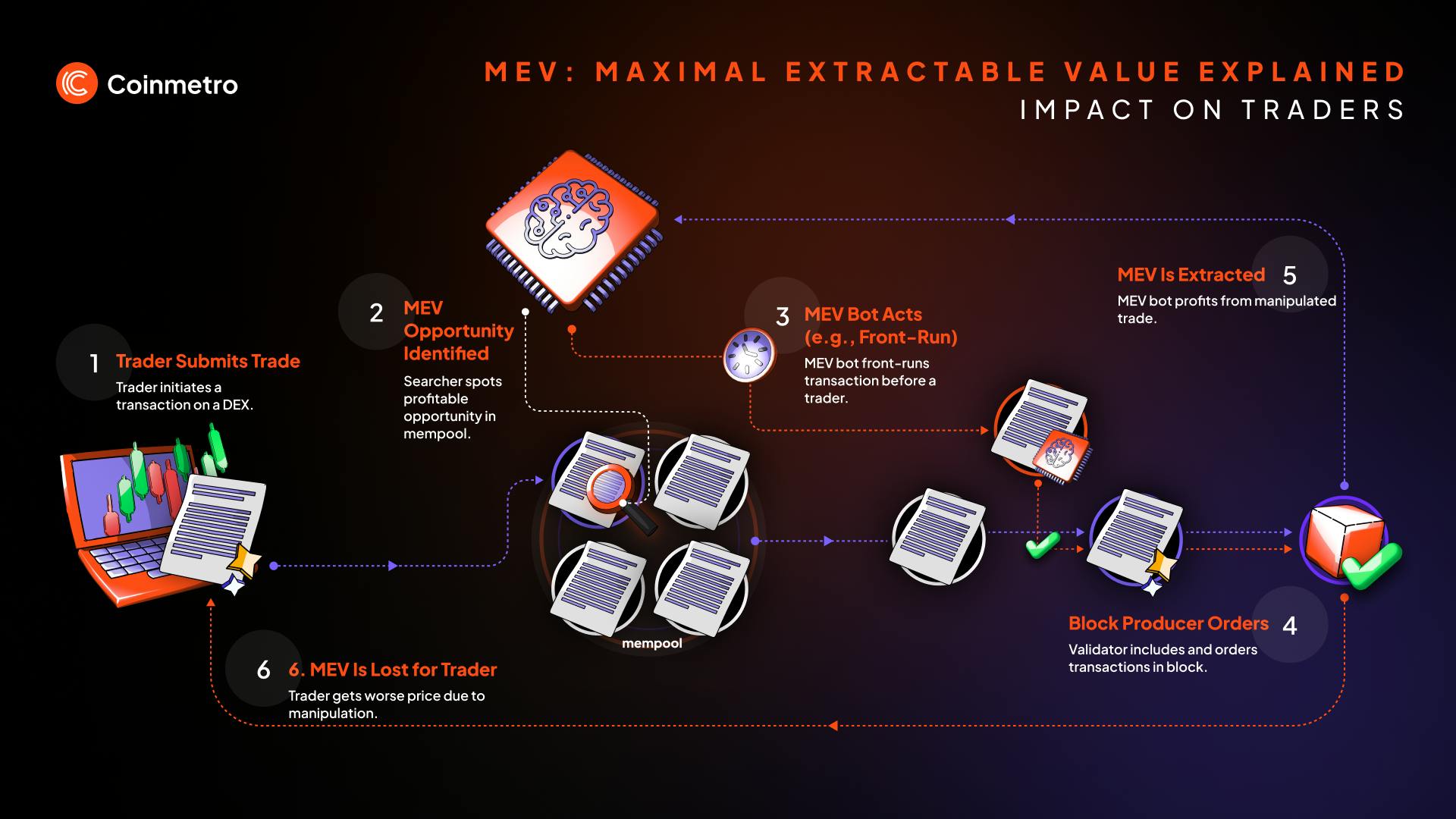
To adapt, leading searchers are deploying agentic AI systems that operate with greater sophistication than static scripts. These AI agents analyze on-chain data in real-time, identifying complex, multi-step opportunities that human-coded bots would miss. This shift from rule-based execution to adaptive, machine-learning-driven strategies is the primary driver of current MEV 2026 trends, creating a high-tech arms race where speed is less important than strategic foresight.
The following comparison highlights the transition from legacy tactics to the new EIP-7702-compatible strategies that dominate 2026.
| Strategy | Legacy (Pre-EIP-7702) | 2026 EIP-7702 Compatible |
|---|---|---|
| Execution Model | Static scripts, hard-coded rules | Agentic AI, adaptive learning |
| Primary Target | Simple arbitrage, sandwich attacks | Complex bundle optimization, MEV-Boost |
| Transaction Type | EOA-only, rigid gas limits | Account abstraction, dynamic gas |
| Competitive Edge | Raw latency, colocation | Strategic prediction, cost efficiency |
This evolution means that competition is no longer just about who has the fastest node, but who has the smartest model. Searchers who fail to integrate these advanced AI capabilities will find themselves priced out of the most profitable blocks, as the remaining alpha is increasingly concentrated in the hands of those who can predict market movements before they happen.
Decentralized MEV Protection Mechanisms
The architecture of MEV 2026 trends is shifting from pure extraction to sophisticated protection. As EIP-7702 introduces new account abstraction capabilities, the traditional public mempool is becoming an increasingly hostile environment for standard users. The primary goal for 2026 is not just to find arbitrage, but to shield transaction integrity from predatory bots that scan public order flow.
Decentralized protection mechanisms focus on private transaction relays and encrypted mempools. These tools allow users to opt out of public exposure, effectively reducing the attack surface for front-running and sandwich attacks. By routing transactions through private channels, users ensure that their trade details remain invisible until they are included in a block, neutralizing the advantage of high-speed searchers.
The integration of MEV-Boost and similar private block-building frameworks has already begun to decentralize the search for MEV. However, the next phase involves user-side protection. Validators and searchers are increasingly collaborating to offer "privacy-first" transaction inclusion, where the relay itself cannot see the transaction contents. This shift ensures that MEV opportunities are captured through legitimate arbitrage rather than predatory manipulation.
This evolution is critical for the health of decentralized finance. As MEV becomes more complex, the ability to transact without exposing intent becomes a fundamental requirement for user adoption. The trend points toward a future where privacy is not an optional feature, but a standard protocol layer in the Ethereum ecosystem.
Faq: mev 2026 market: what to check next
How does EIP-7702 change searcher competition?
EIP-7702 introduces account abstraction that allows externally owned accounts to temporarily delegate authority to smart contracts. This lowers the barrier to entry for MEV strategies, shifting competition from pure hardware advantages to sophisticated smart contract logic. Searchers must now optimize for code efficiency alongside block space acquisition.
What is the impact of MEV 2026 trends on validator yields?
Validator yields in 2026 reflect a blend of base staking rewards and MEV income. According to current market data, Ethereum staking yields sit at roughly 2.78% base APR, with MEV-Boost adding an additional 0.5–1% for validators. This supplemental income remains a critical component of validator profitability in the current MEV landscape.
Will MEV 2026 trends affect everyday users?
While MEV is often discussed in technical circles, its 2026 evolution directly impacts transaction costs and execution quality. Increased competition among searchers can lead to higher gas fees during peak times, but improved transparency mechanisms also reduce the risk of front-running for retail users.
No comments yet. Be the first to share your thoughts!